
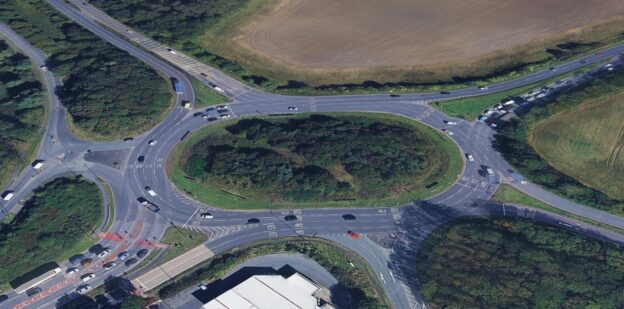
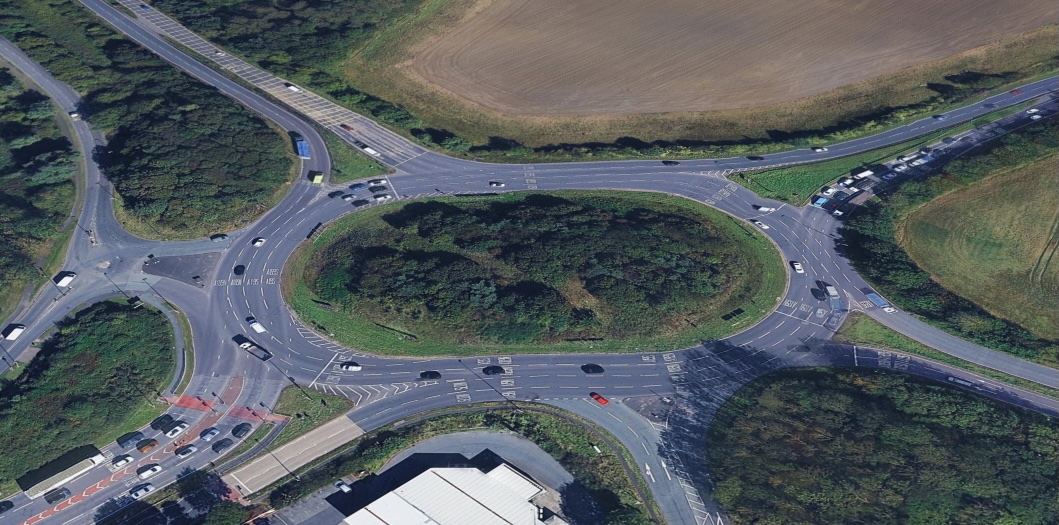
Moor Farm Roundabout – Image Google Earth 2024
National Highways are consulting on proposed “improvements” to the A19 Moor Farm roundabout. On the National Highways Consultation website they say the roundabout “experiences significant congestion during peak travel periods”. Local MP Emma Foody has called the roundabout “a notorious accident hotspot”.
You can reply on the consultation website by 28 July 2026. We suggest that rather than spending hundreds of millions of pounds on a giant overpass, it focuses instead on simpler safety measures, improving public transport and improving safety for people walking or cycling.
What are the issues with the proposals?
1. Throwing good money after bad
The current Moor Farm Roundabout is the result of a previous “improvement” in 2008. This improvement, to widen the roundabout and introduce traffic lights, was intended to improve traffic flow and safety. So what went wrong?
Simply put, bigger roads induce more traffic. Journey-time benefits of bigger roads and junctions are typically short-lived. Even if this junction is upgraded, it will only be a few years before local politicians are calling for yet another capacity increase.
One reason why traffic has increased at Moor Farm is the increased capacity at the Silverlink junction between the A19 and A1058 Coast Road. If capacity is increased at Moor Farm, most likely a further upgrade will next be required at Seaton Burn.
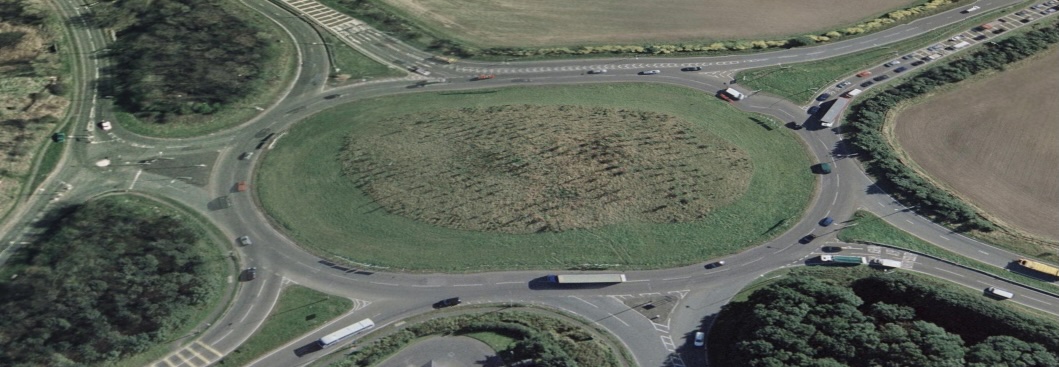
Previous layout for Moor Farm Roundabout – Google Earth 2005
2. Huge Cost
In 2025 the Local Democracy Reporting Service reported the huge cost of roundabout upgrades on the A19 in Northumberland. At the time, the cheapest option E was reported to cost £300m. This is one of the options being consulted on and involves a new overpass between the A19 and A189. Of all the options, this was the only one where benefits (typically measured over 60 years) were greater than projected costs. Given the last upgrade only lasted <20 years, this feels optimistic.
The article also reports that if Seaton Burn junction also needs to be upgraded (likely in our view if Moor Farm goes ahead) that would cost £770m.
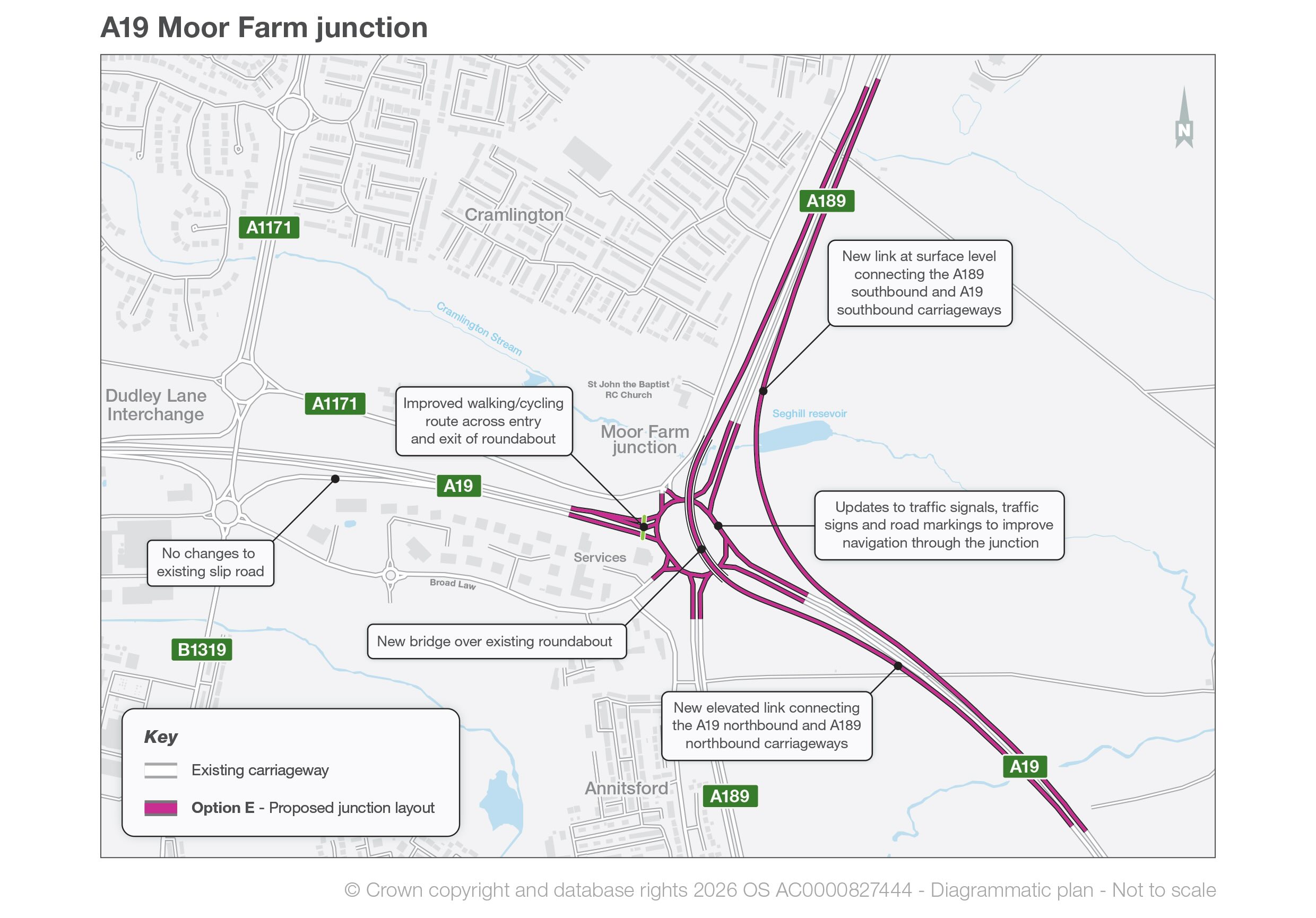
National Highways – Moor Farm upgrade option E
While safety is important, and worth spending money on, collisions stats at Bluehouse and Haddricks Mill show similar numbers of injuries to Moor Farm and no one is suggesting spending £770m to make those roundabout safer.
3. Car dependent development
Currently, despite upgrades being judged poor value for money, National Highways has a “holding objection in place to planning applications in the area”. This, apparently, is based on a concern that further development will make congestion at Moor Farm worse.
This traffic is not just going to stop at Moor Farm. Quite a bit of it is likely to find its way into Newcastle and North Tyneside, potentially making congestion worse across the region and negatively impacting road safety across a wide area.
Car-dependent development, of the sort Moor Farm will enable, is known to be less economically productive, less sustainable, and has a negative impact on people’s health and wellbeing.
Cramlington, which already has 12 miles of traffic-free cycleways, is only four miles north of Quorum and Balliol business parks, and not much further from Longbenton and Freeman Hospital employment sites, but undertaking that relatively short journey by bike is near impossible due to lack of any safe routes.
Alternatives
New government guidance on how to evaluate schemes says “Objectives should ideally be expressed in terms of outcomes [like safety, economic growth], rather than outputs [like giant junctions]. There is often more than one type of output that can be used to deliver an outcome, and so the use of outcome-based objectives encourages practitioners to think through different potential outputs that might achieve their goals.”
Imagine what could be done if instead of spending £300m on just one junction, the money was used to improve sustainable travel more widely. By way of comparison, the entire Northumberland Line from Ashington to Newcastle cost £336m. According to Active Travel England, £291m is enough to build 300 miles of new walkways and cycle lanes. This would create better options for how to travel rather than more unsustainable car-dependency.
One alternative to the roundabout plans would be to fund improvements to Cramlington’s rail services, which SENRUG (formerly known as the South Northumberland Rail User Group) are currently campaigning for. Travelling from Cramlington is a journey approximately 14 minutes to Central Station or 11 minutes to Manors Railway Station, which is as quick as Metro journeys within Newcastle and faster than travelling by car, especially during rush hour traffic.
At a very minimum National Highways need to come up with other options to meet the desired outcomes that don’t involve more traffic. Given the best current option only just breaks even, it shouldn’t be hard to come up with something better.
Respond to the Consultation
You can respond to the consultation website by 28 July 2026.
We suggest asking for further options that improve safety without increasing traffic levels, that prioritise public transport and active travel, and target a substantially higher benefit to cost ratio than would be achieved with the current two options.
Footnote – Learning from the South
A study published in 2021 titled “Economic benefits of road widening: Discrepancy between outturn and forecast” assessed whether benefits forecast when the M25 orbital motorway north of London was widened were actually achieved.
The study concludes that despite promises of faster journey times “the absence of observed increase in traffic speed [after the first year] raises questions about the applicability of a long-established transport model and of travel time savings as the main economic benefit of road investment, as well as about the value of investment to increase the capacity of strategic roads where these are used extensively for local trips.”
This is the same flawed transport model that is being used to justify the Moor Farm project.