

Wordcloud of Lib Dem values
It’s all change at Newcastle City Council, with the Newcastle Liberal Democrats to take control having agreed a “Stability and Cooperation Agreement” with Newcastle Green Party.
According to a Green Party post on X “the Liberal Democrats will form the administration and take executive responsibility for leading the council, while the Greens will serve as a co-operative opposition through a confidence-and-supply arrangement.”
SPACE for Gosforth previously published the local election manifestos for the Liberal Democrats and Green Party. In this post we wanted to dive a bit deeper and look at the Lib Dem values and what they might mean for transport in the city.
The Lib Dem values are: Liberty, Equality, Democracy, Community, Human Rights, Internationalism and Environmentalism. https://www.libdems.org.uk/values
Liberty We believe in the right of individuals to make their own decisions about how they live their lives, as long as they do not cause harm to others.
Individuals are obviously free to make their own decisions about how to travel, and should be able to travel without fear of harm. Potential harms that can be experienced when travelling include anti-social behaviour, dangerous or careless driving, air pollution or noise.
Where people, or a form of transport, is responsible for causing harm to others then it is reasonable to regulate or restrict that harm to minimise its impact, for example via speed limits or traffic restrictions.
Relating to choice, in their manifesto the Lib Dems stated that “Infrastructure should not lock people into any mode of transport.” and that they will “design the city for the way people want to live and travel, providing a range of options and facilitating choice.” One form of this, car dependency – where it is not possible to access local services without a car, is so common it has its own Wikipedia page.
Relating to harms, they said they would “work with neighbouring authorities to ensure traffic ingress doesn’t negatively impact Newcastle’s air quality, particularly on major routes like the Coast Road.”

Air pollution on The Coast Road 2024 exceeding legal limits that should have been met in 2005.
We hope this commitment will also extend to Gosforth High Street. While pollution levels have reduced, and have been within the legal limits for five years (since the CAZ and change to a single lane in each direction), pollution will still negatively impact people’s health. As the Royal College of Physicians said in their 2025 report, there is no safe level of air pollution.
Equality Ensure that no one is held back by poverty, poor health, or discrimination
Owning a vehicle is expensive, so it is important to ensure that low-cost options like walking and cycling are safe and accessible options for the everyday journeys that people need to make.
Walking and cycling also help improve health both directly for the person travelling, but also because they don’t emit polluting gases.
Democracy Every citizen is empowered to make their voice heard, without being dominated by entrenched interests or the power of money;
Citizens were already empowered via the elections just gone to make their voice heard by voting for the party or candidates that most reflected their views. In addition, changes to transport already require far more consultation with the public than other Council functions. The challenge will be for the Council leadership to identify “entrenched interests” and ensure they do not dominate the discussion about the future of the city.
Community Provide support for a diverse range of organisations that enable individuals to join together in the pursuit of common goals or activities.
In the Newcastle Lib Dem manifesto they committed to “establish a single Transport Forum where all stakeholders sit in the same room to solve problems collaboratively.”
Human Rights Reject all prejudice and discrimination based upon race, ethnicity, caste, heritage, class, religion or belief, age, disability, sex, gender identity or sexual orientation
Transport should be usable by all regardless of age, disability, sex or other listed characteristics.
In a recent survey, 9 in 10 women said they fear cycling in UK cities, 79% of women said they fear being hit by a vehicle, 62% are scared of road rage or harassment, and 56% of women fear cycling at night.
Separate polling for Active Travel England found that 57% of women and girls had used other transport modes such as taxis or being picked up in a car instead of walking because of safety worries.”
Traffic also severely impacts children’s ability to travel independently.
Streets frequently aren’t accessible due to broken pavements and pavement parking, and cycle routes are not well designed for adapted cycles that may be wider or longer than a standard bicycle.
An RNIB report from 2015 listed the most common obstructions for blind and partially sighted people:
- cars parked on pavements (70 per cent )
- bins of all kinds (64 per cent)
- permanent and temporary street furniture (59 per cent and
55 per cent) - advertising boards (49 per cent).
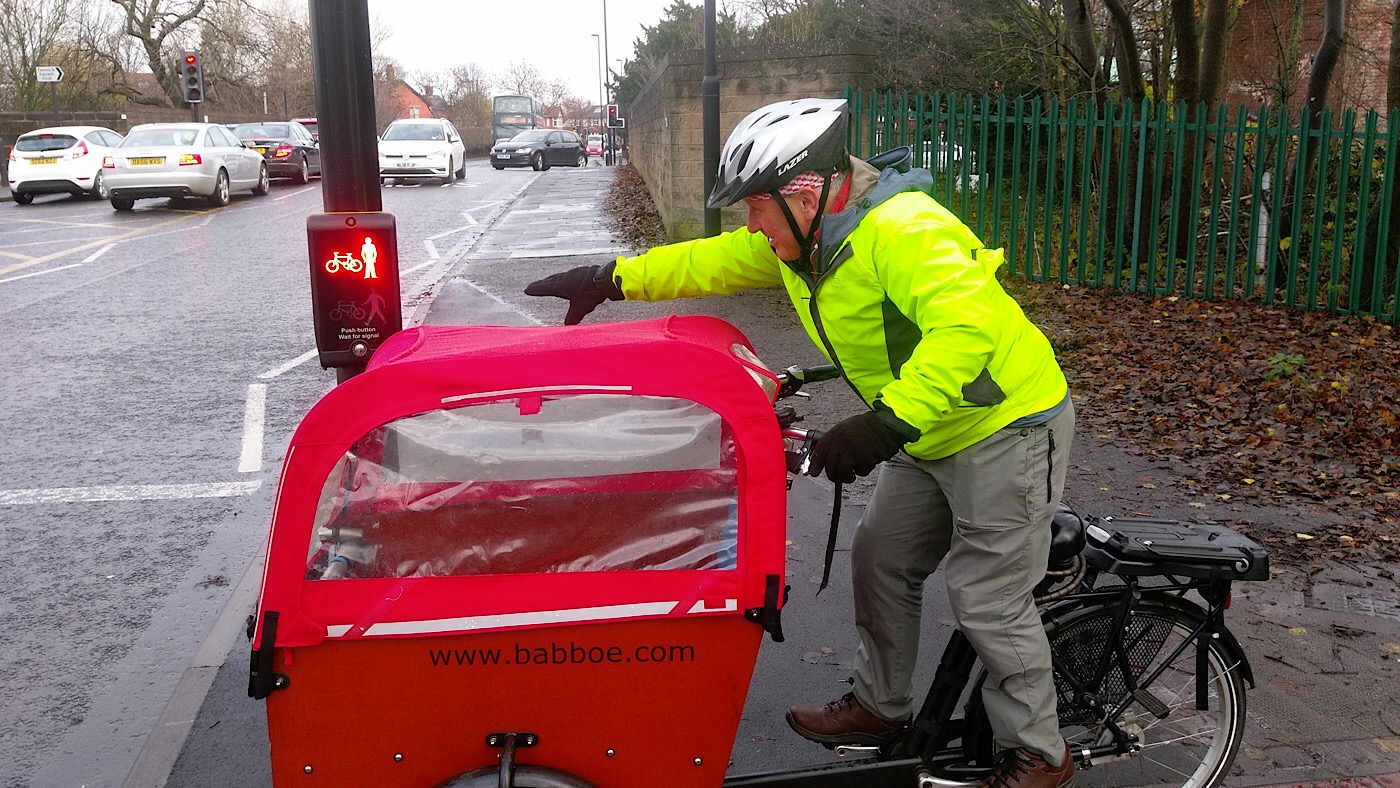
Photo from SPACE for Gosforth’s blog on adapted cycling
Internationalism We believe that our country and our people thrive when we are open and outward-looking.
We hope this means the Council will be outward-looking to learn best practice for transport from leading cities across Europe and the rest of the world, not least from Newcastle’s twin city of Groningen.
In addition, eighteen million people live in the Netherlands, most of whom cycle and many of whom might be tempted to holiday in the NE by bike if safe routes existed from the North Shields ferry terminal.

We could do with a regional cycle-tourism plan.
Environmentalism We value the importance of acting at home and internationally to promote environmentally sustainable means of production and consumption and living in harmony with nature.
Walking and cycling are the most environmentally sustainable forms of transport, with the least impact on nature.
A study from 2021 found that “Cycling is ten times more important than electric cars for reaching net‑zero cities“
Conclusion
Lib Dem values strongly align to SPACE for Gosforth’s objectives for walking and cycling to be safe, practical and attractive travel options for residents of all ages and abilities.
We hope the new Council administration will act accordingly.