
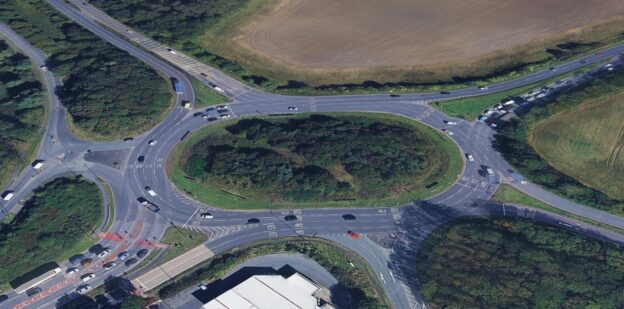
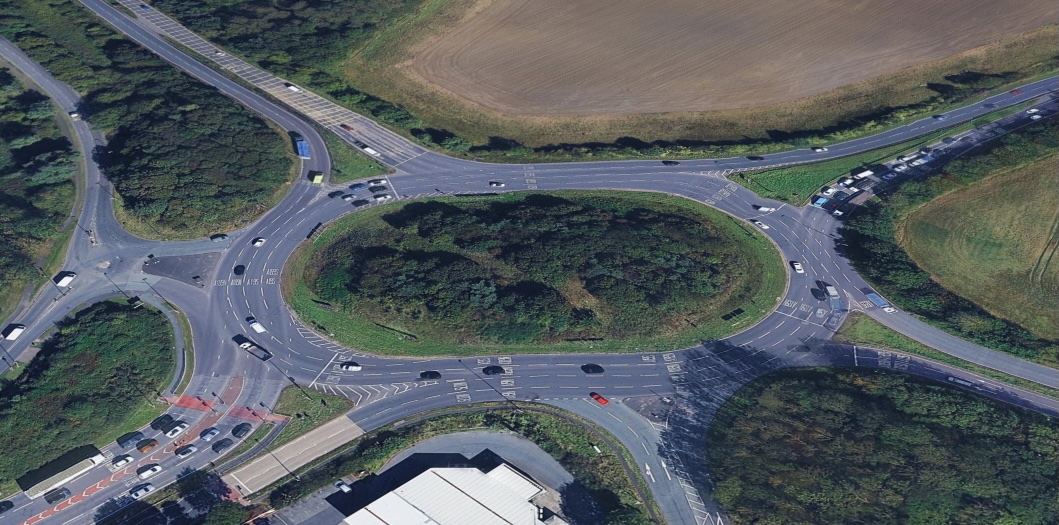
Moor Farm Roundabout – Image Google Earth 2024
In July 2026, National Highways consulted on its proposed two options for increasing vehicle capacity at Moor Farm roundabout on the A19 just north of Newcastle. In our response, set out in full below, we suggest that rather than spending hundreds of millions of pounds on a giant overpass, National Highways focuses on simpler safety measures, improving public transport and improving safety for people walking or cycling.
Further details about the scheme can be found on the National Highways consultation website.
National Highways are due to publish a summary consultation report by 20 October 2026 (12 weeks after the consultation closed).
SPACE for Gosforth’s Response
Dear sir/madam,
Thank you for the opportunity to comment on the Moor Farm Roundabout proposals.
We are a community group based on Gosforth approximately five miles south of the junction. Our aims include improving road safety especially for people walking and cycling, and avoiding the negative consequences of excessive vehicle traffic including air pollution, severance, noise pollution and greenhouse gas emissions.
In recent years Gosforth has suffered from air pollution and high traffic levels, in part due to traffic originating north of Newcastle.
Our assessment is that the negatives of the scheme will substantially outweigh the benefits regardless of whether option D or option E is selected. Our view is that National Highways should set out a further option in line with its sustainability objectives and consistent with the [2025] NE Local Transport Plan objective to create “A green, integrated transport network that works for all will make sustainable transport more attractive, convenient, and safer for the movement of both people and freight.”
Our reasons are as follows:
1. The consultation brochure confirms that both option D and option E will:
(a) have a negative impact on noise, cultural heritage, landscape, biodiversity, drainage and the water environment, soils and carbon emissions;
(b) have a large or moderate negative impact for construction over a period of three years, a moderate negative impact due to land take; and
(c) cost hundreds of millions of pounds to build, potentially not even breaking even, according to National Highways’ own calculations, in the next 60 years.
2. The predicted benefits to vehicle journey time under option D or option E will likely be short-lived. For example when the M25 was widened journey times returned to where they were before the change after only one year. If the same happens at Moor Farm, that’s three year’s disruption for only one year of benefit.
https://drivingchange.org.uk/disappointing-economic-benefits-from-widening-the-m25/
3. While we support improving road safety and safer walking and cycling routes, far greater benefit could be achieved for far less cost if the budget was allocated differently. On the Great North Road in Newcastle, for example, there were approximately 90 injuries due to road traffic collisions between Brunton Park and Blue House roundabout between 2021 and 2025, compared to about 25 in the area of Moor Farm roundabout.
[Collision data from: https://tinyurl.com/necasualtydashboard]
4. DfT’s 2022 guidance on “Strategic road network and the delivery of sustainable development” states “New development should be facilitating a reduction in the need to travel by private car and focused on locations that are or can be made sustainable.” Both options D and E would induce traffic and increase travel by private car.
https://www.gov.uk/government/publications/strategic-road-network-and-the-delivery-of-sustainable-development/strategic-road-network-and-the-delivery-of-sustainable-development
5. The leader of Northumberland Council has all but admitted that new developments enabled by National HIghways’ proposals will cause significant increases in traffic and car-dependency. We presume National Highways understands this given the holding objection he references.
https://www.chroniclelive.co.uk/news/north-east-news/how-long-awaited-moor-farm-33671573
6. While Moor Farm is mentioned in the NE Local Transport Plan, the options proposed run counter to the plan’s core aim to create “A green, integrated transport network that works for all will make sustainable transport more attractive, convenient, and safer for the movement of both people and freight.” The Integrated Sustainability Assessment for the plan also stated that “New infrastructure should be designed to minimise the risk of encouraging more car trips and to minimise whole life carbon impacts through careful scoping, design and material choices.”
7. The same guidance referred to in (4) states that National Highways “will support initiatives that reduce the need to travel by private car and enable the necessary behavioural change to make walking, wheeling, cycling and public transport the natural first choice for all who can take it.” Yet, National Highways has not presented an option for consultation to achieve this. This would be consistent with Green Book guidance which recommends focusing on outcomes like safety and sustainability, rather than outputs like a bigger junction.
8. According to the Institute of Civil Engineering, “Civil engineers are creative problem solvers. They work in harmony with the natural environment to keep towns and cities running and to build a more sustainable world.” An overpass is neither a creative solution, nor in harmony with the natural environment. We are sure other better options are possible.
https://www.ice.org.uk/what-is-civil-engineering
Based on the above we ask that National Highways creates a new option that:
- Increases the capacity of the junction for buses, walking and cycling without increasing traffic levels.
- Enables the use of dedicated bus infrastructure to speed up emergency services response times.
- Supports sustainable economic and housing growth, using the improved junction as a hub to link new developments to existing local destinations via sustainable transport options.
- Supports Northumberland Council to create a new safe cycling link from Cramlington (that already has 12 miles of traffic-free cycleways) to the Killingworth cycle network to create a continuous cycle route to business parks north of Newcastle.
- Supports the NE LTP objective to “make sustainable transport more attractive, convenient, and safer”.
- Promotes the use of the new Northumberland Line and East Coast mainline as an alternative to using the A189.
- Creates multiple options to cross the A19 safely walking and cycling, for example at Dudley Lane.
- Is consistent with local authority, Mayoral Strategic Authority and National Highways carbon reduction targets.
We look forward to seeing your response to the consultation feedback.
Yours faithfully,
SPACE for Gosforth.
National Highways’ proposed options D & E
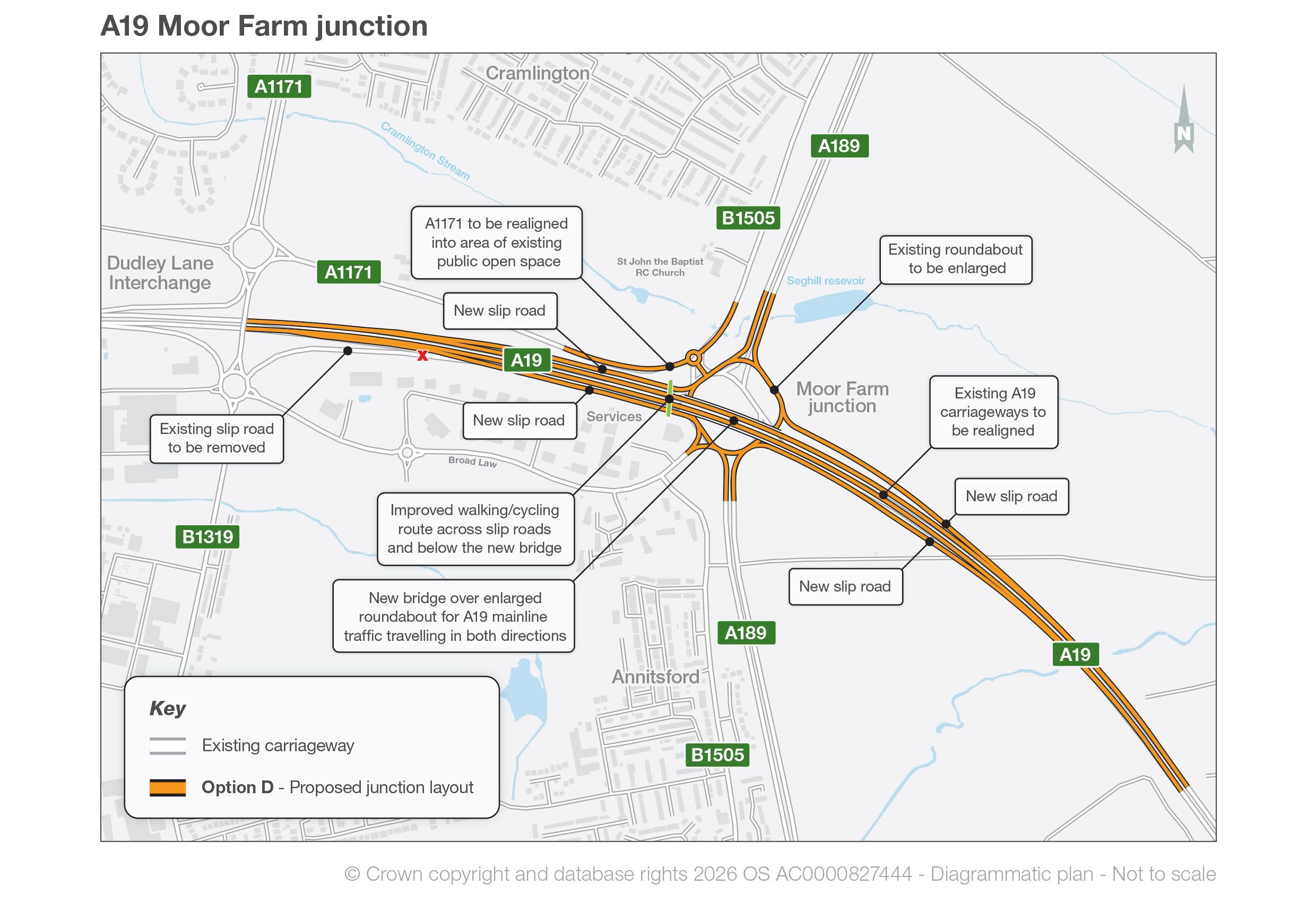
National Highways – Moor Farm upgrade option D
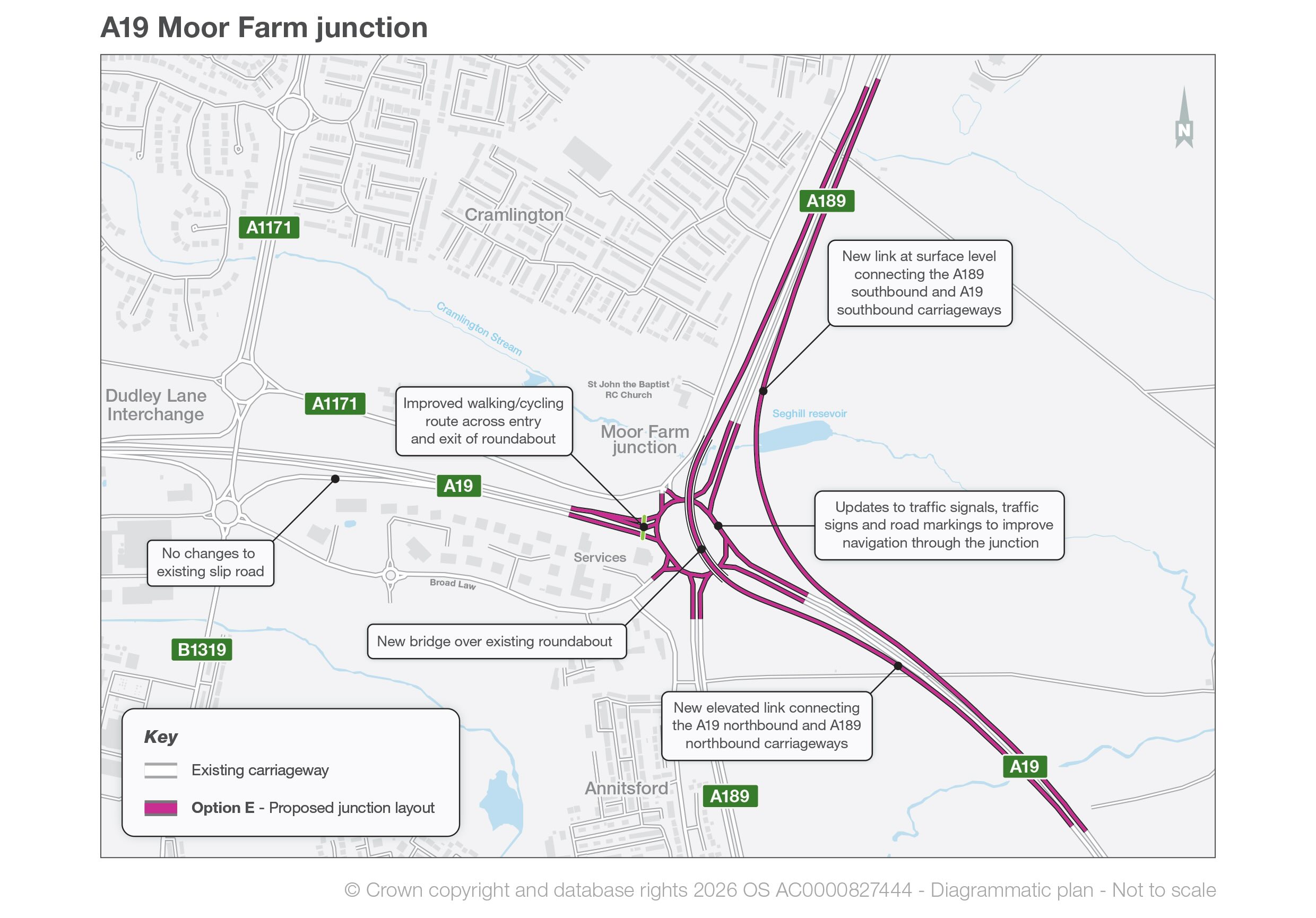
National Highways – Moor Farm upgrade option E
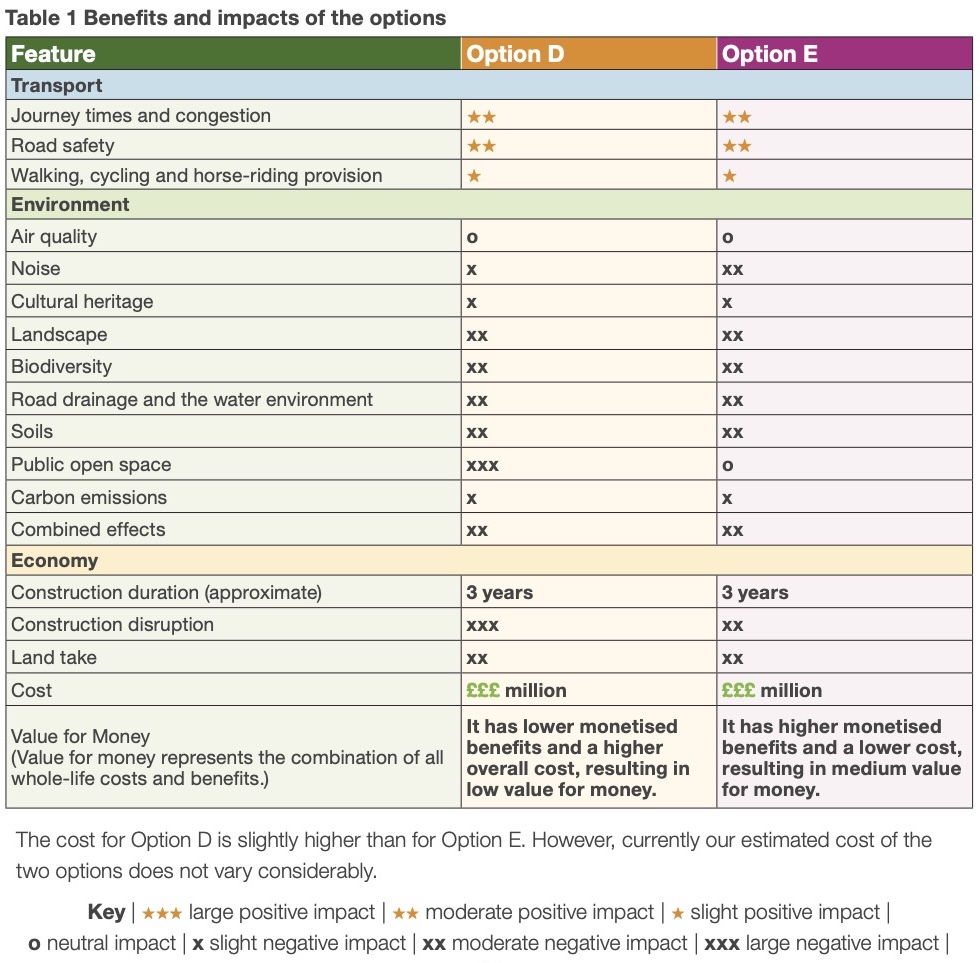
National Highways’ assessment of Moor Farm benefits and (negative) impacts of options D and E